
 Sandton Lifestyle Team
Monthly Digital Cover



Taking a strategic first step into helping professions

One of the characteristics of Gen Z’s work aspirations is the importance they place on working with purpose. These are young people whose childhoods have been immersed in content about the environmental, social, economic and geopolitical upheavals over the past couple of decades. They have their own ideas about the state of the world they are inheriting as adults, and they want to be part of finding solutions to the issues that concern them, and that have impacted their mental well-being for years.
Now that they are entering workplaces, Gen Z wants more than a monthly salary, they also want careers that are meaningful and aligned with their worldview. Many feel drawn to helping professions, such as counselling, coaching, therapy, personal and community development, because they value well-being, personal growth and empathy for others. While AI is shaping the helping professions, as they are every industry, when it comes to mental health, relationships, and personal growth, people still want to talk to people. The need for trained professionals who can listen actively, empathise, help problem-solve, and guide is not just unchanged but growing.
The rising tide of mental health challenges
One of the reasons for Gen Z’s interest in the helping professions is their personal focus on their own experience of mental health challenges such as anxiety, stress, and depression. Worldwide, these conditions are on the rise, especially among younger adults. Unlike previous generations who are still unlearning the stigmas attached to mental health, many younger adults have experienced, or have wanted, mental health and counselling support as they grew up. Prioritising mental health is more widely regarded as a part of responsible self-care.
One of the reasons for Gen Z’s interest in the helping professions is their personal focus on their own experience of mental health challenges such as anxiety, stress, and depression. Worldwide, these conditions are on the rise, especially among younger adults. Unlike previous generations who are still unlearning the stigmas attached to mental health, many younger adults have experienced, or have wanted, mental health and counselling support as they grew up. Prioritising mental health is more widely regarded as a part of responsible self-care.
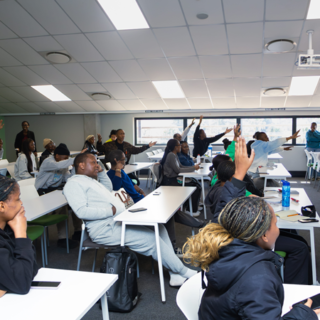
Content such as SACAP’s (South African College of Applied Psychology) recent webinar, Understanding & Managing Anxiety is aimed at giving young people basic knowledge and practical tools to optimise their well-being.
Anxiety is a normal human response to perceived threats, stress and uncertainty that primes us physically and cognitively to have a fight-flight-freeze-or-collapse response. But anxiety can also arise when these responses are not so effective, such as if we are facing financial problems or are in tricky social situations that require clear thinking, problem-solving and measured actions. We can also linger in a state of anxiety to the detriment of our focus on work, life and important relationships.

To disrupt an inappropriate state of anxiety, SACAP’s counselling experts recommend the following self-soothing techniques:
- Self-awareness – so that you can identify your anxious state in the moment and then track the effects on your body and behaviour. It also includes gaining an understanding of your triggers to mitigate anxiety. Self-awareness gives you a measure of control in the moment and enables you to take a different action to help soothe your anxiety.
- Breathing techniques – anxiety goes hand in hand with fast, short, shallow breaths and it is not possible to maintain an anxious state while you breathe slowly and deeply. This is why breathing techniques are a highly effective short-term solution. It gives you a pause to change the thoughts that are triggering your anxiety, and to find a different perspective on the problem that does not reignite the anxious state.
- Movement – for instance, going for a walk helps to shift your perspective. Through movement, you allow your body to change your mind and disrupt the anxiousness.
SACAP’s Head of Faculty for Applied Psychology, Dr Vikki Botes says “These techniques are examples of the real-world knowledge, skills and tools that people in helping professions learn to master.”
Why helping professions are future-proof
Unlike many careers threatened by AI and other tech, helping and caring professionals are in demand because of our preference for human connection, experience, empathy, judgement, and trust. The aspirations to ‘live your best life’ and ‘optimise yourself and your life’ have become entrenched as the popular mantras of today’s world. This comes with elevated expectations of achieving perfect work-life balance, peak standards of physical and mental health, optimum productivity, and all-around positive relationships. High expectations alone though, are not enough.
Unlike many careers threatened by AI and other tech, helping and caring professionals are in demand because of our preference for human connection, experience, empathy, judgement, and trust. The aspirations to ‘live your best life’ and ‘optimise yourself and your life’ have become entrenched as the popular mantras of today’s world. This comes with elevated expectations of achieving perfect work-life balance, peak standards of physical and mental health, optimum productivity, and all-around positive relationships. High expectations alone though, are not enough.
Vikki adds, “People also need a certain level of psychology literacy and practical tools they can use to enhance their goal setting, planning, executive functioning and emotional regulation. It is through engaging with skilled counsellors, coaches, therapists and facilitators that they gain a greater understanding of their own motivators and behaviours.”
A smart and strategic first step into the helping professions
For young people who think that a career in counselling, coaching or therapy may be their route to working with purpose, SACAP’s two-year Diploma in Counselling and Communication Skills is ideal for opening up a range of career pathways in the helping industries. Dr Vikki Botes concludes, “Rooted in applied psychology, this programme provides a fascinating deep dive into human behaviour, emotions and relationships. Students learn hands-on counselling techniques and how to support others through challenging life events and stressors, as well as conflicts and mental health challenges. With 200 hours of work-integrated learning, graduates gain real-world experience and work-readiness. The diploma also provides the required credits to seamlessly step up into a related SACAP Bachelor’s Degree programme. Whether you want to build a career in counselling, HR, coaching, or community development, or simply want to understand and support people better, this programme gives you a strong and respected foundation.”
For young people who think that a career in counselling, coaching or therapy may be their route to working with purpose, SACAP’s two-year Diploma in Counselling and Communication Skills is ideal for opening up a range of career pathways in the helping industries. Dr Vikki Botes concludes, “Rooted in applied psychology, this programme provides a fascinating deep dive into human behaviour, emotions and relationships. Students learn hands-on counselling techniques and how to support others through challenging life events and stressors, as well as conflicts and mental health challenges. With 200 hours of work-integrated learning, graduates gain real-world experience and work-readiness. The diploma also provides the required credits to seamlessly step up into a related SACAP Bachelor’s Degree programme. Whether you want to build a career in counselling, HR, coaching, or community development, or simply want to understand and support people better, this programme gives you a strong and respected foundation.”
 Sandton Lifestyle Team