

 Sandton Lifestyle Team

Monthly Digital Cover



Hardware vs. Software: The Local Dimming Distinction Every Buyer Should Know
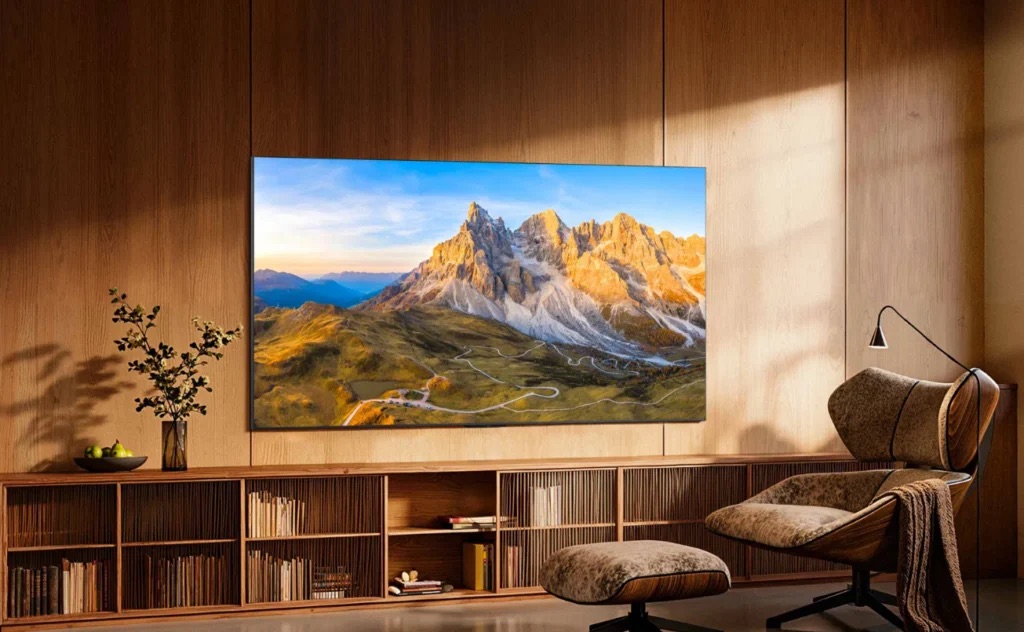
Of all the specifications buried in a television’s marketing copy, “local dimming” is probably the most consequential and the least understood. It is also where the biggest gap opens up between a television that performs the way Mini LED is supposed to and one that only resembles it on paper.
Local dimming, at its simplest, is a television’s ability to adjust brightness independently across different regions of the screen, rather than lighting the entire panel at one uniform level. Done well, it is the difference between a night sky where individual stars burn bright against a genuinely black backdrop, and a night sky that reads as a flat grey rectangle with a scattering of pale dots on it. Both technically have “stars.” Only one of them looks like a night sky.
Two very different ways of getting there
The critical distinction — and the one that rarely gets explained in-store — is how that dimming is actually achieved. Hardware local dimming physically controls the brightness of clusters of LEDs behind the screen, zone by zone, in real time. Because the light source itself is being switched on, dimmed or turned off at the point of origin, it is capable of producing high contrast: deep, accurate blacks sitting immediately next to bright highlights, with minimal light bleeding between the two.

Software, or “virtual,” local dimming should be distinguished from hardware local dimming because the two approaches control the backlight differently. Rather than controlling the physical backlight with that same precision, it processes the image digitally, without switching off the individual LEDs. Under comparable conditions, this can result in less precise control of dark areas and more visible light leakage, with blacks reading closer to dark grey than true black.
Why the industry doesn’t lead with this distinction
It isn’t hard to see why hardware and software dimming rarely get distinguished on a shelf sign or an ad: the words “local dimming” sound identically reassuring either way, and most shoppers have no reason to know there are two very different technologies hiding behind the same phrase. That asymmetry of information is precisely what makes it worth calling out. A handful of manufacturers do disclose more than most — TCL, for instance, publishes dimming-zone counts across its Mini LED range — but explicit confirmation of hardware-based control is still rare across the industry, and remains a reasonable question for any brand to be asked directly.
The five-second question worth asking
For shoppers, the practical takeaway is simple: the words “local dimming” on a spec sheet or an in-store sign are not, on their own, a guarantee of anything. The single most useful question to ask a salesperson is whether that dimming is hardware-controlled. It takes five seconds to ask, and it is one of the most useful indicators of how precisely a Mini LED TV can control its backlight.
For more information, visit https://www.tcl.com/southafrica/en.
 Sandton Lifestyle Team